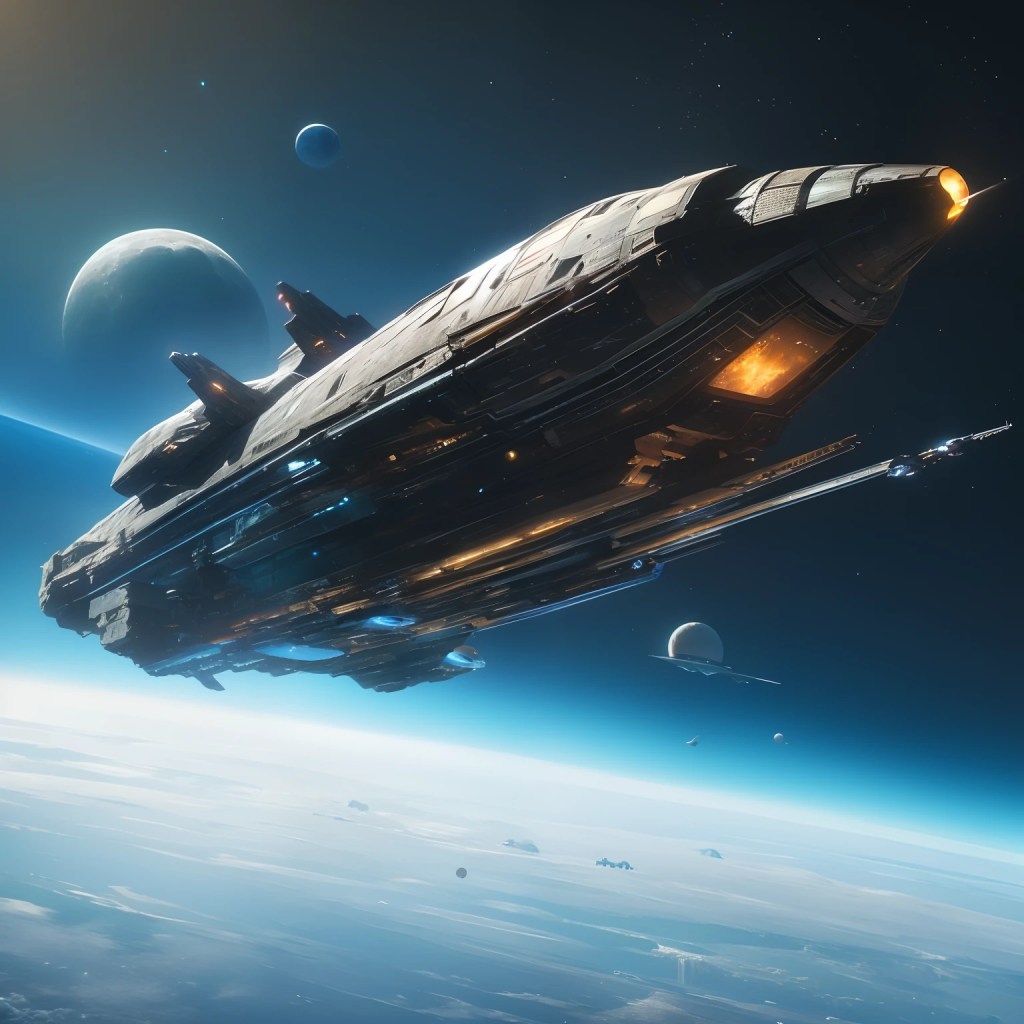
In a lot of ways, science fiction is a genre of contrivances. One of the main questions that crops up in the genre is the title of this very article, and the extent to which the author, director, etc. can make you not care about that question is a pretty strong indication of the overall quality of the story. Making things make sense, especially when you’re writing an entire setting and not just a single work, is vitally important to maintaining quality and building engagement.
More often than not, sci-fi falls back on the Rule of Cool. If something is cool enough on the face of things, then that’s good enough for an explanation. But writing things that are cool is actually really, really hard, so sooner or later a sci-fi writer is going to have to explain how things work.
Consistent and sensible explanations create a framework in which the various mechanics at play can operate. They generate context to the action, and they can also generate conflict. Interesting mechanical explanations can lead to a more engaging story, and a universe that feels thought-out and lived-in, rather than feeling like a game a kid is making up as they go.
In a story with millions miles-long space ships travelling billions of parsecs hither and yon, it’s perfectly fair to wonder why combat on the ground needs to happen at all. Presumably a space ship of sufficient displacement has enough guns to bombard any enemies they come across into radioactive ash, so why not just settle disputes that way and be done with it?
The biggest reason is that ground combat with soldiers and tanks is really cool, so naturally we’re going to include it in the setting. So now we have to contrive a reason why it would happen at all.
Economics
War is expensive. Interstellar war is exponentially more expensive. Wars of total annihilation are vanishingly rare, so the only reason to build up an army is for conquest. Maintaining the existing infrastructure of a planet you plan to conquer is generally somewhere on the invading army’s priority list. The lighter touch of a ground war is preferable to flattening a city from orbit and hoping you killed all the enemy combatants before landing.
Targets of invasion are very much aware of the possibility of orbital bombardment, and thus will usually take that into consideration when planning and building their defenses. Bombarding stout defensive structures can be as effective as throwing eggs at a brick wall.
War ships are very expensive pieces of military hardware, regardless of where you are in the galaxy. For wary commanders, their use in the cauldron of war is thus done very carefully, and in circumstances where it makes sense to do so.
Gravity
Maintaining a position in orbit around a planet usually requires a ship being in geostationary orbit. Each world has its own orbital band where geostationary station-holding is possible, and this band is generally too far from the surface of the planet to be useful for anything other than communication and reconnaissance (we’ll explore why in a bit).
Moving any lower to make landings or support ground troops requires the use of a gravity manipulation device, usually called “Gravity Anchors,” or simply “anchors.” This piece of equipment is found on any ship that will need to remain on station lower than geostationary orbit. It allows a ship so equipped to move in orbit relative to a stationary target at speeds vastly slower than the many thousands of miles per hour it would otherwise require to remain in low orbit.
While not a perfect explanation, an analogy for the way anchors work is that they extend an invisible, intangible “pole” from the nullifier to the surface of the planet upon which the ship balances. The more powerful the anchor with respect to the mass of the ship, the lower in orbit a ship can hold station.
“Balancing” is the operative term in the above explanation. Ships using their anchors are effectively balancing on a single point. Ships must use their maneuvering and main thrusters to maintain their balance in addition to moving. Impacts from the fire of other ships or anti-orbital ground defenses can disrupt the delicate balancing act the anchoring equipment allows, driving them off course and fatally strengthening the hold a planet’s gravity has on a ship. Ships taking damage so severe that their anchors are no longer allowing them to hold position will usually fire their main engines to gain speed and altitude, allowing more time to get their balance. Even if a ship manages to avoid any damage to its structure, the energy imparted by an impact can still throw it off balance, necessitating a retreat.
There’s only so low a ship can go before the planet’s gravity well claims it. Lighter ships are less vulnerable to sinking, while large warships may not even be able to safely enter low orbit. Landing ships or ground-support ships will often supplement their anchors with downward-facing thrusters or atmospheric engines, allowing them to hold position more reliably and stably.
Gravity anchors are power-hungry devices and can only operate at station-holding power for an extremely limited period of time, usually no more than a handful of hours. After this time, the nullifier must be given time to rest and be maintained. This factor and others we’ll discuss later mean that close-range support from orbit is something of a luxury for troops on the ground.
Fire Accuracy
As mentioned above, warships in lower orbits must conduct a magnificent dance to defy gravity. This becomes even more complex if the ship in question wants to shoot anything.
Minute changes to the direction a gun is pointed when fired can have dramatic effects on where the projectile actually lands. Even a slight shift of a few seconds of angle can change where the round will impact. This is to say nothing of what can happen to the projectile itself while it travels.
Guided munitions can help relieve a portion of this burden, and the ability of these munitions to course-correct has been used by crafty ship captains to confound the point defense systems of enemy ships. Guided munitions, however, are vastly more expensive and laborious to produce than gigantic slugs of metal propelled from a mass driver, or the salvos from batteries of directed energy weapons. Much like warships themselves, guided munitions remain a special use case item.
This aspect of war is orders of magnitude more critical to understand for warships, as the ranges of engagements can stretch across tens or even hundreds of miles. Fire calculations must take into account not just the movement of the target, the effects of a planet’s gravity, intervening conditions, but also the movement of the ship itself as it maneuvers into firing position. Different ships have different ideal engagement ranges for each weapon with which they’re equipped, and managing the range of an engagement is how battles in space are won and lost.
Ships in orbit are particularly vulnerable to anti-orbital ground fire. Many factors that go into landing a hit when a warship fires are simply absent from ground emplacements. They aren’t moving when they fire, and they don’t need to worry about being knocked off course and plummeting into the surface of the planet – they’re already down there. Anti-orbital guns are also generally very well-armored, and need not worry about holding station. Thus, only severe damage to the emplacement will render it inoperable. Warships looking to take on well-defended enemy bases on the ground had best have a good strategy in mind, and excellent gunnery crews to boot.
Conclusion
I think with this we’ve managed to come up with some limitations on space ships that have an internal logic to them, and have at least some plausible grounding. A complete theory of warfare in the Age of Ruin universe will require more work, but for now, this ought to suffice to start making sense of things, and provide a guideline to writers looking to write stories about planetary invasion.

 Age of Ruin
Leave a comment