I’m a bit late to the party on this topic, but that’s never stopped me before.
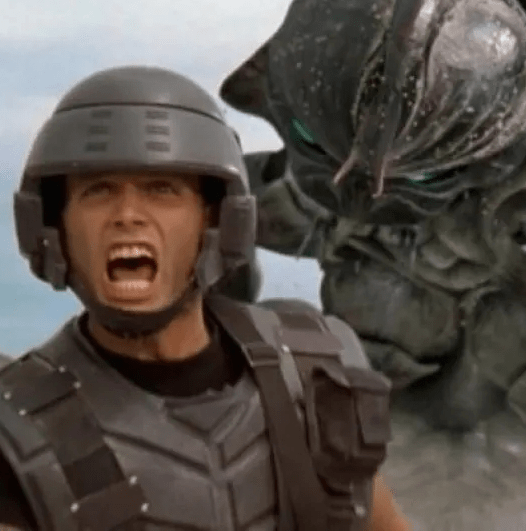
Shortly before the release of Helldivers 2, there was a flurry of discussion about Starship Troopers, the film directed by Paul Verhoeven, and how to properly interpret it. The way most people seem to process the movie is to take the entire thing at face value: a movie about a human military fighting semi-intelligent bugs that threaten their off-world colonies. I think it’s fair to say that most people would call it cheesy, but entertaining.
The general consensus about Helldivers 2 is the same as Starship Troopers: on-the-nose jingoistic fun. In both cases, the term that latched onto the discussion like a barnacle was “Media Literacy.” On the surface, this term means having the capacity to understand what the creator of any given piece of media was trying to accomplish in making it. Some creators choose to make art in such a way as to provoke any reaction at all. That’s the core of modern art. To get you to think, maaaan. Others are much more direct. C.S. Lewis had unambiguous intentions in writing The Chronicles of Narnia: The big lion is Jesus.
In practice, “media literacy” is just grinding up a piece of art and force-fitting it into an explicitly leftist interpretative framework. “Media literacy” is how you get braindead perverts insisting that Frodo Baggins and Samwise Gamgee were gay lovers, despite no indication of such a relationship in the text, Sam explicitly getting married to Rosie and pumping out thirteen more Gamgees, and explicit condemnation of any gay interpretation by the author himself.
“Death of the author” plays an enormous role in being media literate, though only when its convenient. Remember that the goal is not to interpret media properly, but to belittle you for not agreeing with leftist priors. We’ll circle back to that later. “Death of the author” is the idea that any given work of art ought to speak to itself, and that the intent of the creator has no bearing on its interpretation. As with our previous example of The Lord of the Rings trilogy, the intent of JRR Tolkien must be completely ignored to arrive at a flattering interpretation. The author must die.
“Death of the author” is, of course, complete nonsense. Much like “media literacy,” it’s just a gussied up term people use to give themselves permission to adopt headcanon and treat it as having any interpretive value whatsoever. But what does this have to do with satire?
Satire is a genre of art that seeks to promote social change through exposing and highlighting wrongdoing. The mechanism through which this change is meant to be achieved is by inducing shame in the target of a satirical work. This, by the way, is why it’s impossible to satirize leftism: leftists are psychopaths and psychopaths are incapable of feeling shame.
I don’t think there’s a single person who’s a fan of the Starship Troopers films that aren’t aware they were intended to be satirical. In this instance, authorial intent is held to rigidly by the “media literacy” crowd who will scoff at people who enjoyed the films for what they were at a surface level. Don’t you get it? These movies are making fun of you!
As mentioned before, authorial intent matters. Paul Verhoeven very famously refused to read Robert Heinlein’s novel, and so apparently missed out on the fact that Heinlein’s work was written with complete sincerity. What Verhoeven got from the crib notes was that humans were fighting alien insects, and since Verhoeven is a doctrinaire leftist, that means the humans are the bad guys. One of the defining traits of leftism is that they pathologically identify more strongly with outsiders than members of their own kind, to include identifying with a race of fictional, ugly, man-eating insects, and becoming very upset when fictional humans blow them into little chitinous bits in the depths of space.
Casting this type of conflict as a satire could work. Bill the Galactic Hero certainly had satirical elements, lambasting the criminal inefficiency of the military, the horrible pay and conditions, the ghoulish wartime propaganda, etc. Harry Harrison had firsthand experience with his subject matter after having spent years in the Air Force. Starship Troopers falls flat as satire because Verhoeven fundamentally fails to understand what he’s doing making a war movie.
Verhoeven was under the mistaken impression that showing humans being violent towards outsiders would resonate with normal people in the way he intended. People would watch Starship Troopers, see burly men wearing armor and firing guns, blowing alien insects to smithereens and feel a sense of shame and disgust. How awful that these men are defending human colonies!
Instead, everyone rooted for the humans. Duh.
As I mentioned previously, the mechanism by which satire is meant to function is shaming. The way this is done is to craft parallels to the target of the satire and their behavior to what the artist has made. But in order for satire to be effective, the thing that the target of satire is doing in the piece of art has to be bad. Johnathan Swift’s “A Modest Proposal” draws parallels between how poor Irish were treated, and cannibalism.
If you’re reading this, I’m sure you’re on the same page as me when I say that cannibalism is bad. The trouble with the satirical elements in Starship Troopers is that none of them read as bad or wrong to the average person. Like it or not, war is cool. Going out into space with a machinegun is cool. Blowing up hostile alien bugs is cool. Unless they already buy into absurd leftist priors, nobody is going to come away from being portrayed as a man with a sweet gun blowing up the bad guys and getting the girl ashamed of themselves. What Verhoeven intends as shameful would actually be a point of pride for most.
Helldivers 2 is an even more relevant example of the disconnect between leftists and real people. Before I jump into my analysis of how this fails as satire, let’s watch the opening cinematic together:
The cinematic opens with a shot of an idyllic life on Super Earth, which is Earth but better. All the houses and cars look the same, there are armored soldiers walking the streets, and everyone is dressed similarly. The people featured seem generally happy, and the presenter, a normal-looking White guy seems happily married with a child. We’re meant to take this as an indictment of American culture.
The pod-person uniforms are obviously a non-starter and not really worth mentioning. Miscegenation isn’t the brightest idea either. Though if you look closely, the animation team for that cinematic took the time to make the child look mixed-race, which is very funny to me. Aside from that, though, the picture being painted as an indictment of America is vastly superior to what most Americans have in 2024. The neighborhood is clean and safe, with the law actively being enforced. Everyone has a house and a car. It’s obvious that, even if what’s presented isn’t to your liking, it’s worth fighting to preserve.
Contrast that with the high rents, slum lords, increasing cadence of street violence, gay propaganda being force-fed to the most vulnerable, child murder, enshrinement of anti-White hatred, desecration of Christian churches and culture, economic depression, and a sky-rocketing suicide rate. Our civilization craves death and everyone knows it.
You can’t show an audience something that’s better than what they currently have, call it no good, and expect anyone really internalize the intended satirical message. Especially not when the way “our way of life” featured in the cinematic is preserved by blowing up bugs and robots. No amount of out-group preference hammered into the skulls of schoolchildren will make people identify with non-humans unless they’re already screwed up.
Satire, as a genre, is dead. At least for the time being. The people who ought to be satirized feel no shame, so there’s no point in carefully crafting witty retorts to the latest bit of insanity coming from the left. It’s better to point and laugh, and try to excise the the influence clown world has over your life as best you can.

 Age of Ruin
Leave a comment